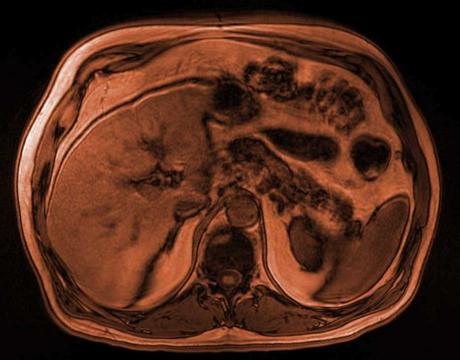
Clinical information: 58-year-old male presents with upper GI bleeding ? Haemoglobin 68.
Interesting case Abdominal 36
.png)
Salient findings
-
At the level of L3, there is atheromatous disease resulting in tapering to complete occlusion of the infra-renal aorta.
-
No flow in the left iliac or left iliac vessels or proximal right common iliac artery.
-
More distally the right external iliac and common femoral arteries opacify likely from collaterals.
-
Occlusion of the SMA near its origin.
-
Prominent arc of Buhler re-establishing flow.
-
Despite the fact that the aorta is occluded at the origin of the IMA, flow in the IMA is preserved from collateralisation with the arc of Riolan, otherwise known as the mesenteric meandering artery.
Principal Diagnosis: Leriche syndrome or aortoiliac occlusive disease.
Other important findings:
-
Previous right hemicolectomy with unremarkable ileocolic anastomosis.
-
No intraluminal arterial contrast ‘blush’ in the upper or lower GI tract, with no intraluminal hyperdensity across the portal venous or delayed phases to suggest a site of active bleeding.
Learning points:
-
What is Leriche syndrome?
-
Leriche syndrome is the complete occlusion of the aorta distal to the renal arteries.
-
It can remain asymptomatic if adequate flow is maintained via collateral vessels.
-
- When it does present symptomatically, what does the patient experience?
-
Leriche triad/syndrome:
-
-
-
-
Erectile dysfunction
-
Thigh and pelvic claudication
-
Absence of femoral pulses
-
-
-
This condition is often chronic, secondary to atherosclerosis and has similar vascular risk factors as such, for example:
-
Diabetes
-
Hypertension
-
Smoking
-
Hyperlipidemia
-
-
It also can present acutely, which carries a worse prognosis and will present with more typical ischaemic signs and symptoms such as the ‘P’s and hence clinically the picture often overlaps with critical limb ischaemia:
-
Paraesthesia
-
Pain
-
Pallor
-
Pulselessness
-
Paralysis
-
View our recent lectures

Latest Content
Clinical information: 58-year-old male presents with upper GI bleeding ?
Clinical information: 77 year old male presents with central abdominal pain.
Clinical information: 36 year old male. Shortness of breath and chest pain.